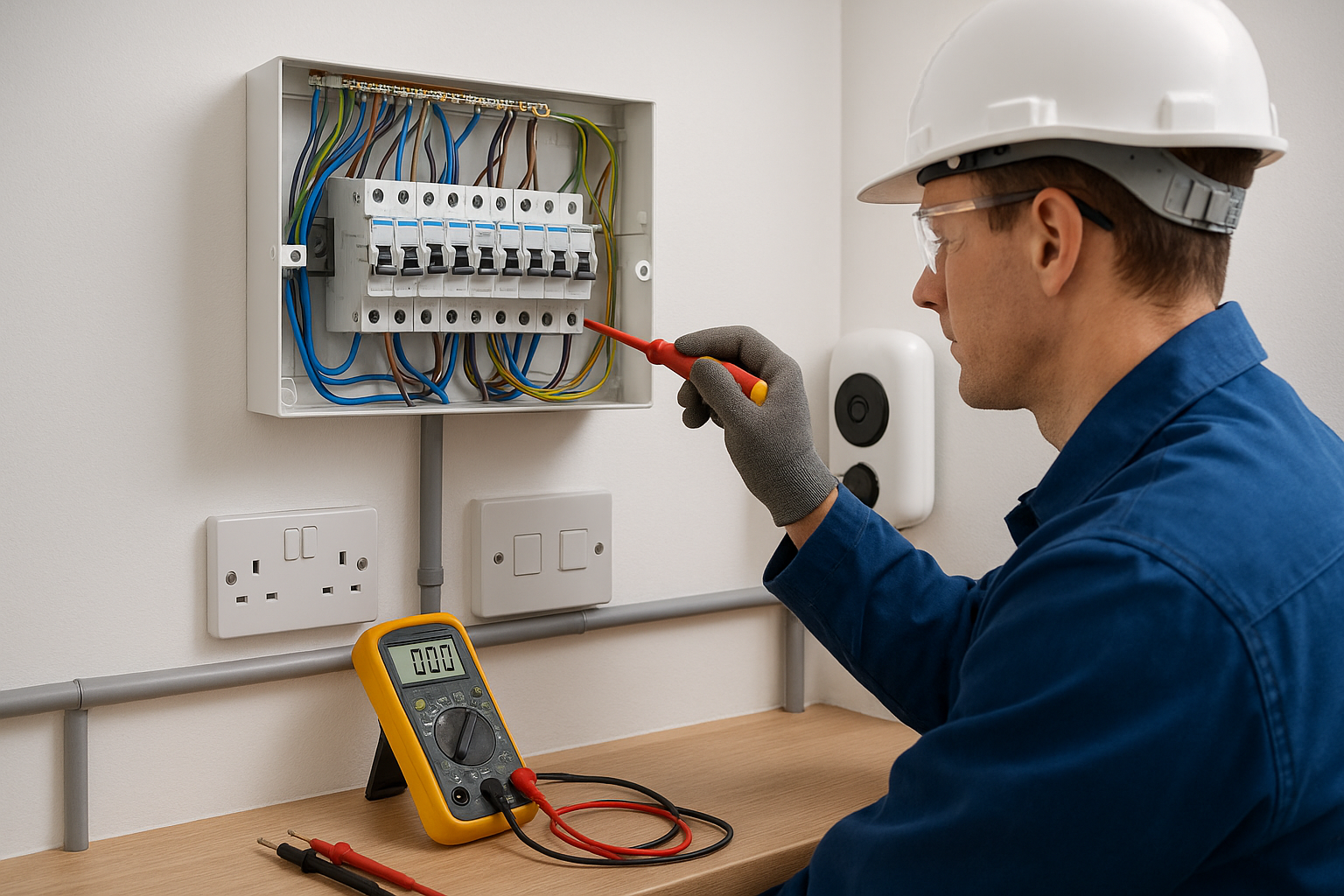
If your fuse box keeps tripping, a breaker will not reset, or part of your home has lost power, ChargeMaster Electricians provides local fuse box repair in Hampstead for homes, flats, landlords, tenants, shops and offices. We help diagnose the cause of the fault, inspect the affected circuit, and carry out the repair or replacement needed to restore safe operation.
Electrical faults around a consumer unit can range from a simple overloaded circuit to a damaged breaker, a loose connection, moisture ingress, or an ageing fuse board that no longer performs reliably. In Hampstead, we commonly help with Victorian terraces, converted flats, older rewires, modern apartments and mixed-use properties where electrical equipment has been added over time. Our work is focused on finding the fault properly first, then advising on the safest next step.
We operate from 24 Pilgrim's Ln, London NW3 1SN and cover Hampstead and nearby areas including Belsize Park, Swiss Cottage, Highgate, Golders Green and West Hampstead. If you need practical help with fuse box fault finding in Hampstead, tripping breaker investigation in Hampstead, RCD nuisance tripping in Hampstead, faulty breaker replacement in Hampstead or fuse board safety checks in Hampstead, call 020 3633 2069 or email info@hampstead-electricians.co.uk.
For urgent electrical issues, our service is available 24 hours. If you smell burning, see scorching, hear buzzing from the consumer unit, or suspect heat damage, switch off the affected circuit if you can do so safely, keep clear of the equipment and arrange an electrician promptly.
We also support related domestic and commercial electrical work, including electrician callouts, emergency electrician visits, electrical repairs, consumer unit work, lighting installation, socket installation, electrical fault finding and domestic electrician services.
Fuse Box Fault Finding in Hampstead
Fuse box fault finding is the starting point when the cause of a power problem is not obvious. A consumer unit can trip because of an appliance fault, a damaged cable, a failed breaker, a loose terminal, a neutral issue, or a circuit that is carrying more load than it should. In older Hampstead homes, we often find a mix of older wiring and later additions, which can make faults more difficult to trace without proper testing.
Common signs that point to a fuse box issue include:
- the fuse box keeps tripping at random
- one breaker will not stay on
- half the house has no power
- lights or sockets work intermittently
- the fuse board feels warm, smells hot or buzzes
- an appliance causes the circuit to fail as soon as it is switched on
We begin by identifying which circuit is affected, then check the pattern of the failure and the condition of the equipment. Depending on the property, that may involve inspection of the consumer unit, testing the circuit, checking connected accessories, and looking for signs of wear or damage at switches, sockets, light fittings and junction points.
In Hampstead, this service is often useful in Victorian terraces and converted flats where circuits may have been extended over time. It is also relevant in shops and offices near Hampstead High Street or around Hampstead Underground Station, where a fault can affect working hours, lighting or essential equipment. If the issue is linked to a circuit fault rather than the fuse box itself, we will explain that clearly so the right repair is carried out.
Tripping Breaker Investigation in Hampstead
A tripping breaker is a warning that the electrical system is detecting a problem. It should not be ignored, and it should not be repeatedly reset without understanding the cause. A breaker may trip because of overload, short circuit, earth fault, damaged equipment or a wiring issue on the circuit it protects.
Our tripping breaker investigation in Hampstead is designed to separate an appliance problem from a circuit problem. For example, if the breaker trips when a kettle, heater or washing machine starts, the fault may sit with the appliance or the demand placed on the circuit. If it trips with no obvious load, the cause may be within the wiring, the breaker itself or another part of the installation.
We look at the affected circuit and the equipment connected to it, then test in a logical sequence to narrow down the cause. That helps avoid guesswork and avoids unnecessary replacement of parts that are still serviceable. Where needed, we can also advise on related electrical repairs or lighting installation if the issue is found to be in a fitting, switch or accessory rather than the consumer unit.
Homes around Parliament Hill, Keats House and Hampstead Heath often include older layouts, loft conversions and added circuits, so a breaker trip may point to a fault that has developed gradually. In shared buildings and managed properties, we also help landlords and property managers understand whether the issue is local to one flat or part of a wider supply arrangement.
If you are dealing with repeated trips, do not keep forcing the breaker back on. That can make the fault worse and may create a safety risk. Arrange a proper inspection instead.
RCD Nuisance Tripping in Hampstead
RCD nuisance tripping happens when residual current protection operates even though the fault is not immediately obvious. It can be frustrating, especially when it affects lighting, kitchen sockets or essential equipment, but the device is often doing its job by reacting to an imbalance or leakage on the circuit.
In practical terms, nuisance tripping can be caused by a faulty appliance, damp in an outdoor accessory, ageing wiring, a neutral-earth issue, or a circuit with several small leakage sources adding up. It can also happen after new equipment has been installed and the electrical load profile has changed.
Our approach is to check the installation carefully rather than simply swapping parts. We examine the RCD-protected circuits, review the symptoms and carry out testing to identify whether the cause is the board, the circuit or something connected to it. If the issue is linked to an appliance or accessory, we will explain the next step clearly. If the board itself is outdated or unsuitable for the property’s current electrical demand, we can discuss consumer unit work as a longer-term option.
RCD issues are common in flats and converted properties in Belsize Park, Swiss Cottage and West Hampstead, where kitchens, bathrooms and modern appliances can place different demands on older wiring arrangements. If you are not sure whether the trip is due to a real fault or a nuisance issue, it is best to treat it as a fault until tested properly.
For safety, keep the affected area clear, switch off the relevant circuit if needed and avoid using damaged equipment until the problem has been assessed.
Faulty Breaker Replacement in Hampstead
If testing shows that a breaker is faulty, replacement may be the correct repair. Breakers can wear out, become mechanically unreliable or fail to reset properly after repeated fault conditions. A faulty breaker can cause frequent interruptions, false tripping or a circuit that will not remain energised even when the rest of the installation appears healthy.
Before replacing any breaker, we check whether the underlying issue sits elsewhere in the circuit. Replacing a breaker without tracing the cause can lead to the same fault returning. That is why our process includes inspection and testing first, then repair advice based on the result.
Where a replacement is appropriate, we will discuss the condition of the existing consumer unit and whether the board is still suitable for the property. In some homes, especially older rewires or properties with a mixture of original and updated circuits, a single breaker replacement may solve the immediate issue. In others, the consumer unit may be dated enough that broader upgrade work is worth considering.
This is particularly relevant in Hampstead properties that have been adapted over many years, such as converted flats near Hampstead High Street or older houses close to Hampstead Heath. If the board is overcrowded, poorly labelled or showing signs of heat damage, we may recommend a more comprehensive review rather than a narrow repair.
We never advise customers to open the fuse box themselves. Consumer unit work should be handled by an electrician, and any work that falls under Building Regulations should be properly assessed and certified where required.
Fuse Board Safety Checks in Hampstead
Fuse board safety checks are useful when you want reassurance about the condition of the consumer unit, especially after a fault, after a property changeover, or when the installation has not been reviewed for some time. A safety check can help identify signs of wear, overheating, poor labelling, unsuitable devices, loose terminations or evidence that the board is no longer keeping pace with the property’s current use.
In Hampstead, safety checks are often requested by landlords, tenants, managing agents and homeowners preparing for repairs, letting or renovation. They are also sensible in older homes where the electrical installation has evolved in stages. We regularly see older fuse wire boards, ageing consumer units and mixed installations that deserve a proper look before the next fault appears.
During a safety check, we assess the consumer unit and the condition of the affected circuits, then explain what we find in plain English. If there are signs that the installation needs further attention, we can discuss practical next steps such as fault finding, breaker replacement, socket installation, lighting installation or a wider consumer unit review.
For landlords and property managers, this can be especially helpful where a flat or commercial unit is occupied and faults need to be handled with minimal disruption. For homeowners, it offers a clear view of whether a recurring problem is isolated or part of a wider electrical issue.
Nearby locations we cover include Belsize Park, Swiss Cottage, Highgate, Golders Green and West Hampstead, so if your property is just outside Hampstead we can still help.
What to do before an electrician arrives
If a fuse box fault has affected your property, the safest immediate step is to switch off the affected circuit if you can do so safely, avoid using damaged sockets or appliances and keep clear of any equipment that is hot, buzzing or scorched. If the entire property has lost power, check whether the issue is limited to one circuit or the full installation, but do not remove covers or attempt wiring repairs yourself.
If you are a tenant, let your landlord or managing agent know what has happened. If you are a homeowner, make a note of which appliances were in use when the fault occurred, because that information can help narrow down the cause. For example, a breaker that trips when the oven is used may point to a different issue than one that trips when lights are switched on.
We use that information alongside inspection and testing to identify the fault efficiently and safely.
Local electrical help in Hampstead and nearby areas
ChargeMaster Electricians supports domestic and commercial customers across Hampstead and the surrounding neighbourhoods. We regularly work near Hampstead Heath, Hampstead Underground Station, Hampstead High Street, Keats House and Parliament Hill, and we also cover nearby homes and premises in Belsize Park, Swiss Cottage, Highgate, Golders Green and West Hampstead.
Whether the issue is a fuse box that keeps tripping, a breaker that will not reset, an RCD that trips without warning, or a board that needs a safety check, we aim to give clear advice and a practical repair path. Where the fault is elsewhere in the installation, we can also help with electrical fault finding, emergency electrician callouts, electrical repairs and related domestic electrician work.
To arrange fuse box repair in Hampstead, call 020 3633 2069 today. You can also email info@hampstead-electricians.co.uk with your address, a short description of the fault and any symptoms you have noticed. We will help you move towards the right repair, not just the quickest guess.
ChargeMaster Electricians, 24 Pilgrim's Ln, London NW3 1SN.